

Engineered Dependency and the Coming AI Protection Racket
What coal company towns and AI cybersecurity threat hype have in common
Quick note: longtime subscribers will have noticed I’ve been posting infrequently the last 6 months; I promise to only write something when I have something to say, rather than try to rig the algorithm by constantly publishing, in order to save your inboxes, and our sanity.
Imagine a company invents and patents a synthetic form of breathable air, which promises to make those who breathe it healthier and more efficient. The air is at first produced by a small appliance you install in your home like a mini-split air conditioner, and it’s instantly popular with fitness enthusiasts and gyms. As adoption grows, the company releases larger units that will pump the air into entire single family households and commercial buildings, as well as a portable version that users can take with them wherever they go.
Initially the appliances and devices are the only cost for the consumer, and the synthetic air itself is free since it can be produced from the surrounding air with minimal other inputs that cost nearly nothing. The air machines become wildly popular, particularly after a period when the machines themselves are offered at an artificially low price to consumers and hyped in a months-long marketing blitz. Due to the company’s spectacular growth, it attracts record-setting investments, first from venture capital, and then from public markets.
As it turns out, once you consume the synthetic air habitually, it’s physically challenging to live without it and go back to normal air. Indeed, the younger a person is when they first develop the habit, it becomes more difficult to breathe regular air. Retail businesses and restaurants without synthetic air risk failing, as an increasing number of them rely on customers that can now only breathe the synthetic air.
This leads to further adoption, and once a point of saturation is passed, due to pressure from shareholders and investors, the company begins charging for air subscriptions. The company becomes fabulously rich. It uses its wealth to capture government, prevent regulation, and get its synthetic air machines installed in schools, hospitals, airports, and other public spaces, further perpetuating the adoption cycle. Within a handful of years, if you don’t breathe synthetic air, you can’t leave your house and can no longer meaningfully participate in society or the economy.
The synthetic air company is obviously a stand in for today’s largest American tech companies, and if you’re familiar with Cory Doctorow’s concept of enshittification, you’ll recognize part of the cycle. And there’s also a monopoly issue here: obviously once a product becomes a necessity, an unregulated, monopolist can charge whatever they want for it, and that’s usually bad for consumers.
But I don’t want to focus on either of those; rather, it’s the final line of the scenario — that it became impossible to participate meaningfully in society without the machines — that I want to draw your attention to. A company seeking to create this sort of dependency is not new in American business, though, as I’ll get to, it has matured into a new form with social media and threatens to do so with AI.
Before I come back to today’s tech companies, though, let’s talk about coal and Appalachia.
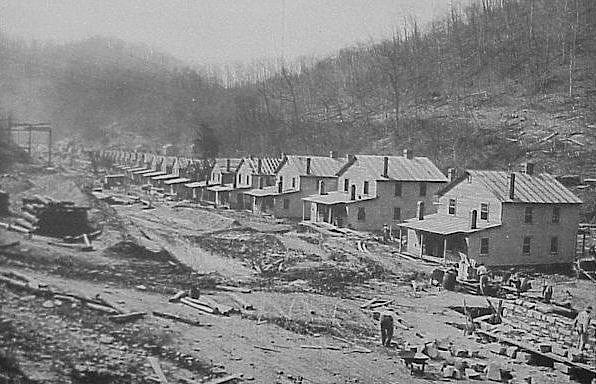
The image above is from a coal company town in Appalachia in the early 1900s. In these towns, the coal mining company not only owned houses like these — built to be identical to house the miners and their families — but also owned the store where groceries and dry goods were sold, the building where the minister preached on Sundays, the school the children went to. The sheriff answered to the company too, as it owned the land everything the sheriff policed was built on.
Before the mining companies came, mountain folk had long lived off the wild commons of the forests, hunting in the hills and farming small plots in the hollers. The economy required little cash because the people required little that couldn’t be hunted, traded, or cultivated. But when the mining companies arrived, they stripped the right to use the land from the people who depended on it. A family that once fed themselves from the woods could do so no longer, but learned that the mine was hiring, and that working in the mine came with a house and a doctor and a school.
Yet the miners weren’t paid in dollars; they were paid in company scrip, redeemable only at the company store, where prices were well above what the same goods cost in a general store. Equipment and rent were deducted before wages were paid, so the miner could spend a month underground and still owe his employer money. Strikes were of course met with intense violence, and the fact that the company owned all the land and controlled the political system meant that other employment options would never be invited in. The only way to leave a job in the mine meant leaving the the region, which for most, was just another way to say there was no way to leave at all.
Working at the mine thus became the condition for access to society and the economy; the companies strangled the oxygen that could have led to alternatives, much like in the hypothetical scenario above with the synthetic air. But importantly, too, the coal companies managed to shape the consciousness in these company towns in such a way that imagining a different world was impossible.
A few weeks ago, I finally deleted my LinkedIn account, after wanting to do it for years. The trigger was that I commented on a post by a “cybersecurity expert” who was objecting to policies that require checking users’ ages for porn or social media. His refrain was a common one: he called me an authoritarian and claimed I was advocating for a dystopian world in which you have to show ID to browse the internet — which I was not. (After a few harassing messages from him, where he also attempted to doxx me and invite a pile-on, I decided this was the sign I needed and deleted what was the only social media account I’ve held since 2014.)
But what this man failed to recall was that there was once a time when the internet was not walled off behind account access and controlled by a handful of companies’ algorithms. Google and Meta, and to some extent Amazon and Microsoft, have created company towns out of the digital, and increasingly, the physical world. A policy checking ages for social media websites only creates the dystopian world he fears to the extent these companies control the internet, which itself is a policy problem. No one is suggesting checking ages on Wikipedia, for example.
Try running a restaurant without managing or paying for a Google Maps or Yelp listing; or any kind of retail store without an Instagram. For those of you with “e-mail jobs,” imagine showing up to work one day and telling your boss you’d no longer be using Microsoft or Office suite. International Criminal Court Judges, after sanctions by the Trump administration in retaliation for issuing a warrant for the arrest of Israeli PM Netanyahu, have found themselves nearly unable to function as adults in Europe because the American companies have locked them out of everything. (There are guides out there to alternatives to American tech — Paris Marx has one, and Brian Merchant recently posted a guide to getting out of Google — but they mostly prove that it is a lot of work for a regular person to un-do one’s relationship to these companies in 2026. I’ve done a lot of it, and can speak from experience.)
Thus, the question we should be asking is not whether having an age check to access Instagram to prevent ten-year-olds from signing up is authoritarian, but rather why checking ages on a few companies with a documented track record of exploiting the vulnerable is such a daunting imposition. It is a bigger problem that we’ve allowed so much unchecked consolidation of power in the digital world such that a few CEOs can dictate the terms of an individual’s participation in society.
This threatens to get worse rather than better in the world of AI. Anthropic’s Dario Amodei wrote in his 2024 essay, “Machines of Loving Grace,” that “Having a very thoughtful and informed AI whose job is to give you everything you’re legally entitled to by the government in a way you can understand—and who also helps you comply with often confusing government rules—would be a big deal.” Indeed it would, and these are often flawed systems, but might we invite in further injustices if access to government services was contingent on paying a month subscription for Claude?
Indeed, beyond the entanglement with government services, I fear OpenAI and Anthropic are attempting to construct a new regime of dependency right in front of our eyes. Recent news about cybersecurity incidents caused by OpenAI and Anthropic’s experiments have focused — as usual — on repeating the companies’ hype about the potential of their products.
Yet I read this differently: in much the same way that a mafia goon could show up at a mom-and-pop store and say, “Gee, this is some nice merchandise here, would be a shame if something happened to it — let us take care of you,” conveniently both OpenAI and Anthropic offer robust cybersecurity solutions for modern businesses. To my point, here is a screenshot of Anthropic’s cybersecurity solutions for business page (OpenAI’s is similar):
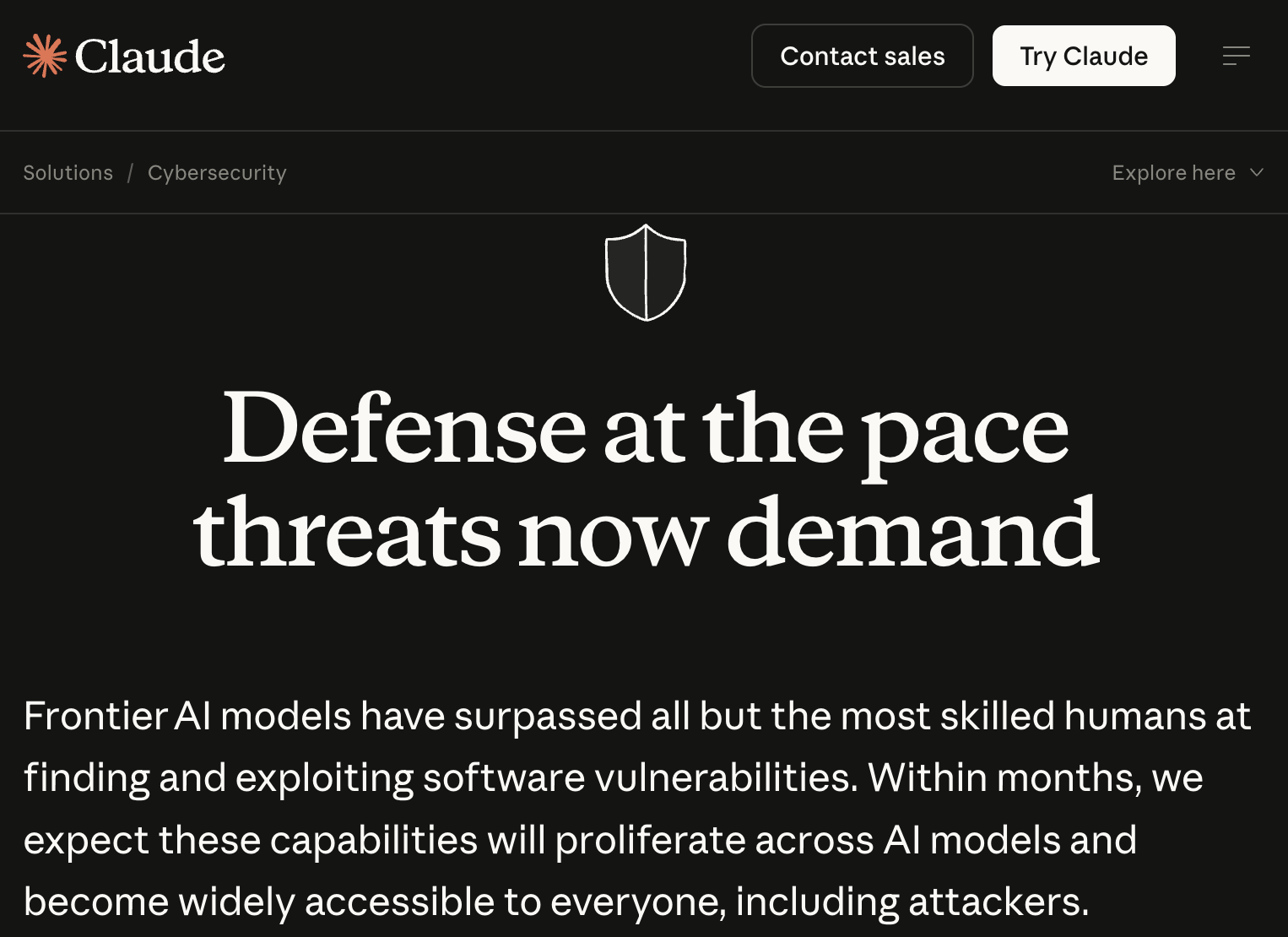
Just like the smallest businesses now have to pay a monthly tithe to Microsoft or Amazon or Google for cloud services and again Microsoft or Google for an office suite in addition to any advertising on Google or Facebook, we can now look forward to a day soon where those businesses can add a tithe to Anthropic or OpenAI for cyber protection (against threats that they themselves unleashed) to their expense sheet.
Ultimately, the coal company towns were broken by the New Deal. Miners gained a protected right to unionize, and infrastructure brought paved roads to the region so that it was easier to escape. But the legacy of those company towns lives on in the endemic poverty of Appalachia — a contributing factor to the ‘deaths of despair’ that became common during the opioid epidemic of earlier this century — as the companies in many cases retained rights to the land that had once sustained the people for generations before even after they gave up control of the towns themselves.
We still can create a world in which participating in life online and offline is not subject to the terms and conditions of tech companies. But the longer these companies are allowed to any strangle economic and social life that they don’t control, the harder it will become to escape.