

The Fox and the Hedgehog
Americans are catching on to Silicon Valley's 'One Weird Trick'
On Sunday, Eric Schmidt stood before the graduating class at the University of Arizona and began talking about artificial intelligence. The boos started almost immediately. This has quickly become a trend: a real estate executive at the University of Central Florida had gotten the same treatment days earlier; bewildered, she asked the crowd, “What happened?” Schmidt said he could hear them, he understood there was “a fear” that the machines were coming and jobs were disappearing, and the commentary has tended to agree (though I think that fear is just slightly off-target).
Yet these speakers have seemed not to consider that the boo birds are calling out for them and what they represent. Young people these days aren’t technophobes. I think they boo because they can see behind the curtain. They’ve lived through one tech promise cycle already: the platform that delighted them until it locked them in, the gig economy that liberated millennials until it exploited them, the social network that connected them until it used those connections against them.
They know how the last movie went, so they’re booing the sequel.
One Weird Trick
“The fox knows many things, but the hedgehog knows one big thing.” That fragment from the Greek poet Archilochus, written in the 7th century BC, survives without context — so it functions as a Rorschach test for us today. You see in it what you’re already inclined to see. But the most common interpretation is straightforward: the fox meets the world with a bag of tricks; the hedgehog has exactly one move.
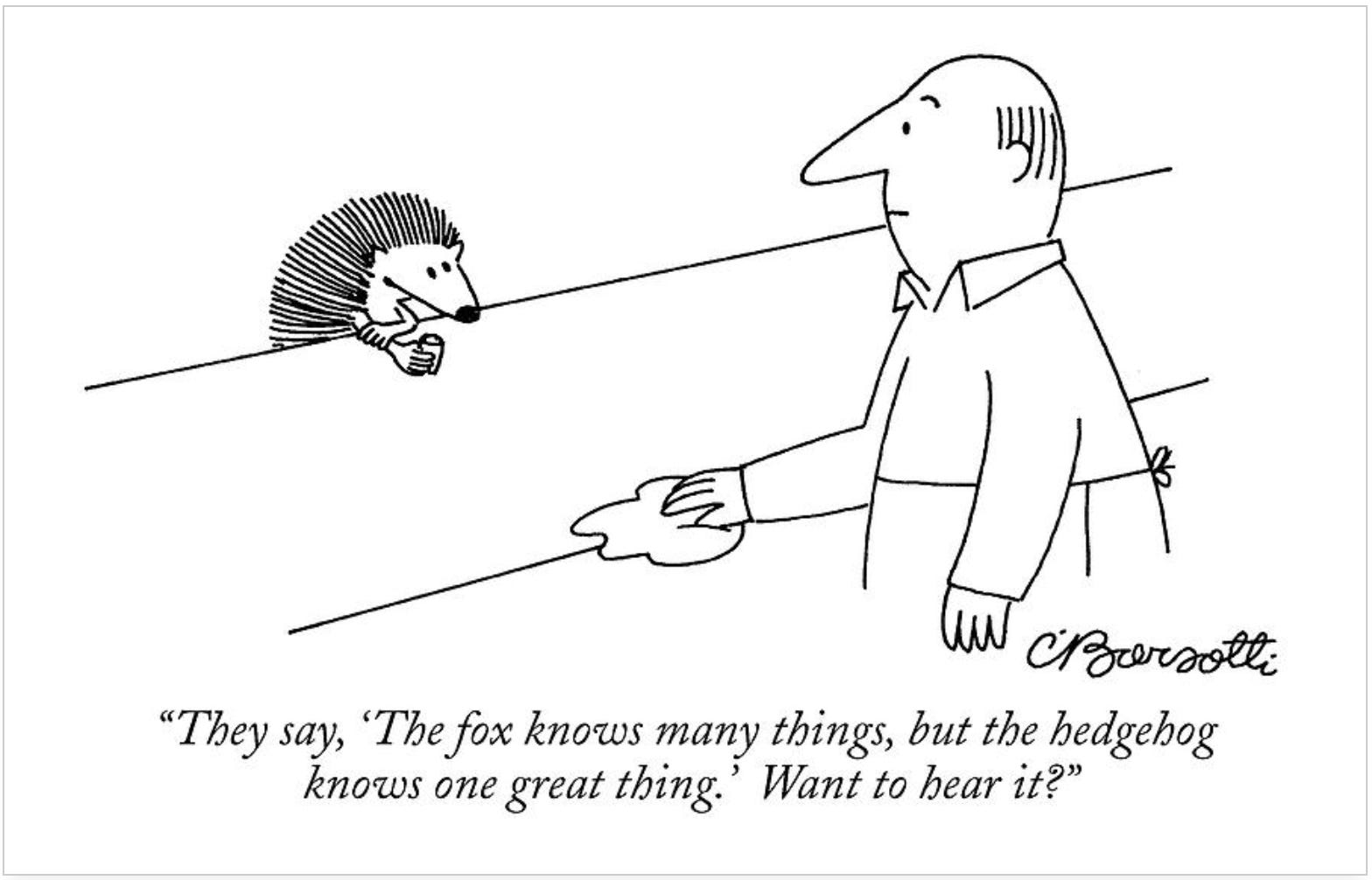
Silicon Valley likes us to think they are foxes: clever and full of innovative new tricks. The familiar refrain from tech execs with AI that we can all now recite is that it will solve cancer, cure climate change, allow the US to beat China, and usher in an era of abundance and prosperity. Increasingly, the American people aren’t buying this — and it’s because when you take a step back and look at the last decade, tech companies aren’t foxes capable of such things; they are hedgehogs capable of just one thing.
When I began working at Amazon in January 2015 on the public policy team, a familiar internal refrain about our mission was to “delight customers,” and an informal tenet was that we were all supposed to ignore the stock price. Jeff Bezos believed that obsessing over Wall Street’s reaction to quarterly returns drove businesses to make ill-advised, short-term decisions, rather than decisions that were best for customers — and in the end, Amazon making decisions that best served its customers would end up serving the business well in the long run. I was perhaps naïve at the time, but it seemed to me to be an earnestly expressed mission, and one that Google, for example, seemed to share. Compared to, say, Wal-Mart — the big retail bully at the time, for whom I’d briefly worked as an outside counsel — this seemed like a gentler capitalism.
Other tech businesses copied the costume of this ethos, Uber being an example. Remember back when, if the smallest thing went wrong with an Uber ride, you’d correspond with an actual human about it, and you’d probably get both a refund on that ride and a credit for a future ride? Compared to the experience of riding in an actual taxicab circa 2012 in the District of Columbia, where I lived at the time, this was a godsend. We know now with the benefit of hindsight that this approach to customer service lost Uber tons of money in the short term, but it won them enough customers — and made going back to the unaccountably rude taxi driver who would only take cash that came before unthinkable — that it created a large enough network effect in the medium term to eventually cut quality for riders and exploit drivers in the long term.
As with Uber, something changed at Amazon roughly around 2018, which is when I began looking to leave. Rather than innovate to delight customers, to the extent the company was innovating, it became to lock in customers and extract more value from them — increasingly in the form of what economists call rents. Not coincidentally, this is around the time that Amazon Web Services reached maturity, and the company became engaged in a bitter legal fight with Microsoft, Oracle, and the first Trump administration over a massive federal cloud services contract; this was also the year of Amazon’s HQ2 sweepstakes, when Amazon’s policy executives managed to offend the entire city of New York with their sneering entitlement to taxpayer dollars to build a helipad in Long Island City. The company became a bully externally, and that changed the culture internally, where bullies also became empowered. Our mission on the policy team had always been to obtain and preserve legal and regulatory flexibility for the business, but the business’s mission seemed to have changed from delighting customers to extracting from them (and from small businesses too).
This is thus tech’s hedgehog trick: scale to where there’s no meaningful alternative to their products, shirk accountability for problems those products create, and extract maximum value. Writer and technologist Cory Doctorow’s concept of “enshittification” is a downstream result of this trick. First the platform attracts users with genuine value, then it exploits them to attract business customers, then it exploits the business customers to extract maximum profit. The hedgehog’s spines then come out. There’s a modern, English pun on ‘hedgehog’ buried here that I don’t think is coincidental to our moment. A hedge, in the financial sense, is a defensive position — a bet designed to protect existing assets rather than acquire new ones. Silicon Valley has become extraordinarily good at hedging: against regulation, against competition, against accountability.
This is why LLM AI will not, under the current system, solve cancer or climate change. Those problems require long time horizons, willingness to fail publicly, cooperations across competitors and with academia and government, and genuine subordination of short-term returns to outcomes that may take decades to materialize. None of that is compatible with a business model built on extraction and rent-seeking. Companies that have spent a decade hedging against consequence have no real incentive to take consequences seriously.
Which brings us to China — and a clear, definitive illustration of what the hedgehog strategy is losing us. While American tech companies have spent the past three years deploying the “race with China” as an all-purpose deregulatory weapon, China is running a fox’s game: focused on efficiency, diffusion, and integration — embedding AI into food delivery, manufacturing, ride-hailing, and the daily friction of urban life. Already more than 600 million Chinese citizens are thought to have used some form of agentic app. Meanwhile, Sam Altman was telling U.S. intelligence officials as early as 2017 that China had launched an “AGI Manhattan Project” — a claim one official later described, flatly, as “a sales pitch.” The race narrative has been useful primarily for one thing: convincing Washington that any guardrail on American AI is a gift to Beijing, and so we shouldn’t have any laws at all. The hedgehog's defense, dressed as a fox's wiles — and enforced by a class of self-styled rationalists for whom the AGI race is less an empirical claim than a loyalty test.
What the Boo Birds Know
I read the boos at graduation ceremonies as not just a rejection of these prophecies as false but also as a collective revelation of what the prophecies themselves stand for. In a compelling recent TED Talk and her recent book Prophecy, Oxford philosopher Carissa Veliz breaks down the political function of prediction: the dressing up of contestable, value-laden decisions as facts that must not be disputed. Véliz argues that AI is the new Oracle of Delphi, and not in a flattering sense. Predictions, she observes, are “speech acts” — commands, rather than statements. When AI companies promote a documentary about the profound stakes of what it’s building, they are issuing a directive about what reality is supposed to become — in this case, who will hold power in the future — and asking you to ratify their vision of the future rather than form your own. The self-fulfilling prophecy is a perfect heist that produces no evidence. If you comply with the oracle’s prediction and the future the oracle describes comes to pass, the oracle looks prescient. The whole time the oracle was determining rather than foreseeing.
The boos at Arizona and Central Florida can thus be interpreted as a refusal to be determined by tech execs like Schmidt, and I for one celebrate the students for their refusal.
As a society — and also specifically on policy — we should avoid being distracted by the fox costume. Treat Silicon Valley promises the way a sensible parent now treats an edtech pitch: proof required, enthusiasm deferred.
The hedgehog only has the one trick — and we know what it is now. The fox, by contrast, knows many things, starting with this: don't let the hedgehog trick you into thinking it's something it isn’t.
I wonder if there’s a structural driver for your observations. It was around 2017-2018 that the major platforms hit genuine market saturation—user growth flattening, core margins compressing as the easy gains were taken. This implies that extraction isn’t (primarily) corruption, it’s rational response to a changed business environment. Lock-in, rent-seeking, regulatory capture, are the moves of an industry that knows its best days of organic expansion are behind it.
This also reframes the AI turn. AI is the only credible answer to the growth narrative problem at the moment. If you’re a platform company with a saturated market and a P/E ratio priced for a growth company, you need a story. AI is that story.
Regardless, your right that this tells us something about the teams leading these companies.
"I read the boos at graduation ceremonies as not just a rejection of these prophecies as false but also as a collective revelation of what the prophecies themselves stand for."
I like the term "prophecy" because I get the sense that have "seen this movie". "The 100", "The Lord of the Rings", "Eagle Eye", "Divergent", "The Hunger Games", "Harry Potter", etc are great explorations of the seductive nature of power, whether it be via tech or magic. They all contain at least an implied sales pitch of " 'we' need to be doing this (so YOU need to be doing this)", "master it or it will master you", and "this is going to be wonderful". The cluelessness of these CEOs who don't understand the fear is remarkable.