

This is the first of “Six Big Questions for 2026” — a week-long series examining the fault lines that will determine whether this year becomes a turning point or a missed opportunity in bringing Silicon Valley to heel and making innovation work for Americans.
I will not be making predictions for 2026 and keeping score. Instead, what I am interested in is locating the points where outcomes are still undetermined and pressure still matters.
The first big question for 2026, on the Democrats, is below. Subsequent questions are posted as Substack notes:
Will the tech oligarchs continue to dominate other Republican factions in the White House?
Will the tech economy exceed America’s "Grift Carrying Capacity"?
How much more aggressive will the tech industry get in buying and using political influence?
Question 5, coming Jan 2, on tech and geopolitics
Question 6, coming Jan 3, on media and polarization
Big Question 1 for 2026: Will the Democrats Figure Out That Taking on Silicon Valley is a Winner?
This fall, a trio of centrist Democratic strategists — people with the ear of party luminaries like David Axelrod and James Carville — released a fifty-page blueprint for how the Democrats can win back America. The Welcome Party's "Deciding to Win" document is meant to guide the party toward victories in the midterms and 2028 and overcome the fact that 70 percent of voters think the Democratic Party is out of touch. It contains detailed polling on immigration, healthcare, economic messaging, and cultural signaling. Yet the words “AI companion” do not appear, nor do “Silicon Valley” or “Big Tech.” “TikTok” and “Instagram” only appear in the context of evaluating 2024 candidates’ effectiveness in reaching voters through social media. (And while I pick on The Welcome Party here, they are not alone: see, e.g., this debrief on the off-cycle elections from November 2025 by Crooked Media, which also fails to mention these issues; in general, center-left Democrats are far more likely to be pushing the “abundance agenda” than confronting technology issues, for a variety of reasons.1)
When technology is mentioned in the report is as telling as when it’s missing. The appendices to “Deciding to Win” do include a page on artificial intelligence, but its focus on bioweapons and “frontier” AI only demonstrates the degree of capture of the party’s thinking by tech elites and effective altruists who have an incentive to make folks believe AI is all-powerful. Beyond AI, tech issues are otherwise relegated to "Other Policies," where the consultants managed to poll a hypothetical restriction of social media to kids under thirteen — which is not only already technically federal law in some respects, but also an absolutely unserious threshold based on what we know about adolescent brain development. It's as if someone asked Americans whether they supported Democrats passing laws limiting car speed limits to 90 miles per hour in school zones.
It’s soon to be 2026, and a majority of teens are interacting with AI chatbots, with predictably dire consequences for their mental health. Many kids received untested and potentially dangerous AI toys over the holidays. Instagram is committed to recruiting teens despite their knowledge their product is toxic for them. Yet center-left consultants are producing strategy documents and polling that treats technology as if it were 2008.

To not have a coherent perspective on the one kitchen-table issue that unites every American family — rich, poor, black, brown, white, gay, straight, Christian, Muslim, Jewish, atheist, college-educated or college-dropout — is political malpractice. The drama most parents experience every evening as their children threaten to vanish into algorithmically-optimized rabbit holes isn't a fringe concern. Policies on tech that do get implemented are popular: four out of five Australian adults support the country’s new prohibition on social media accounts for kids under 16; phone-free school policies are similarly popular as they return near-instantaneous positive results that people can see in their lives on a daily basis. And unlike economic and health policy, effective tech regulations cost nothing and might even save money. And all that’s even before you get to the larger question of whether a representative democracy can even function properly in the outrage-driven media environment tech companies have created over the last fifteen years.
Yet the Democratic consultant class — the party establishment — doesn’t think this issue is even worth polling on, and whether this changes before the November elections is one of the biggest questions for 2026.
Let’s go deeper to understand why this issue is important for Democrats, how they are missing it, and how things might change.
The Epstein Tell
The way Democratic party leaders have framed the issues around the Jeffrey Epstein documents — as opposition research against the President rather than as an indictment of an entire class of elites — suggests they still don't understand the political moment they're living in.
If the Epstein scandal were merely about the President’s associations, Republican figures like Thomas Massie and Marjorie Taylor Greene wouldn’t have been among the loudest voices demanding the release of the Justice Department’s files. As Representative Ro Khanna (D), who co-sponsored the bipartisan discharge petition with Massie, told the Los Angeles Times: “When you take a step back, you have a country where an elite governing class has gotten away with impunity, and shafted the working class in this country, shafted factory towns, shafted rural communities.” As Khanna understands, the scandal resonates across the political spectrum because it confirms what Americans already suspect: that the game is rigged, that the rich and powerful operate by a different set of rules, and that their crimes carry no consequences.
The Epstein emails — showing Larry Summers seeking romantic advice from a registered sex offender, academics providing character references for a convicted predator, lawyers joking with a man they knew to be a monster — offer the clearest possible demonstration of a crisis of elite impunity. These elites didn’t put damning things in writing because they were naive; they did it because they have no fear of accountability. That same indifference to consequence is precisely what Americans see every time a tech oligarch makes billions from products that harm children and walks away unscathed.
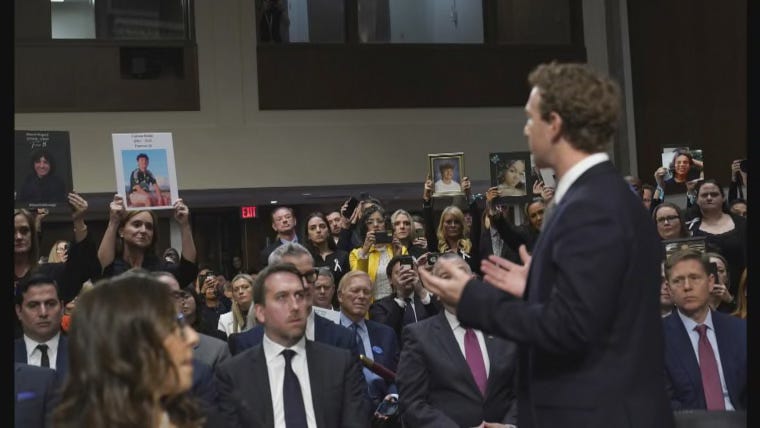
And herein lies the opportunity for Democrats, but so far the party elites are failing to grasp what voters are actually asking for from their political leaders. Mark Zuckerberg and Meta’s executives know their products harm teenagers but ban screens in their own homes; Jeffrey Epstein’s correspondents knew he was a predator but kept seeking his counsel. Both patterns reveal the same truth: elites protect their own and bear no costs for the damage they inflict on everyone else. But of Epstein and Zuckerberg, only one of those two has ongoing impacts on American families. A Democratic Party leadership and consultant class that understood this would recognize that standing up to tech oligarchs isn’t a distraction or niche concern, but rather is the easiest way to show voters they are willing to fight for them.2
The 2028 Test
If you want to see how deeply the Democratic elites’ blind spot runs, examine the candidates being positioned for the 2028 presidential race and ask a question: which of them has actually done anything on tech?
CNN’s recent survey of the Democratic bench profiles roughly ten serious contenders for 2028. Out of those, Mark Kelly, the senator from Arizona, is an exception. He’s co-sponsored the Kids Online Safety Act, introduced other good legislation, and spoken repeatedly about holding tech companies accountable for the content harming children on their platforms. When Kelly talks about these issues, he sounds like someone who has actually listened to the parents in his state — perhaps because, as he put it, “Too many families have seen the real harm social media can cause.”
Kelly aside, the field is barren. Pete Buttigieg has said essentially nothing publicly about the technological transformation reshaping childhood, even if he is thoughtful about artificial intelligence. Josh Shapiro, the governor of Pennsylvania, has won more votes in that swing state than any politician in history, but has done nothing on the issue that polls at 70/30 in every demographic. JB Pritzker has been aggressive in fighting the White House on multiple fronts, but on tech? Also crickets. (Both Pennsylvania and Illinois are also laggards on phone-free school policies.) Alexandria Ocasio-Cortez has not led on tech issues in the House even though she’s the legislative star of the generation that is closest to the acute consequences of Silicon Valley’s products.
Then there’s Gavin Newsom, the California governor who will be term-limited out in 2026 and is running for president in all but name. Tech policy advocates have long hoped California would lead on digital regulation the way it led on auto emissions — that the state’s massive economy would force national standards the way its clean-car rules did. But Newsom faces a structural problem that no amount of political will can overcome: California’s precarious budget depends heavily on taxing tech companies and their highly-compensated employees. If the AI bubble bursts — a subject I’ll address later in this series — California will need every tech dollar it can get. Newsom’s not going to bite the hand that fills Sacramento’s coffers, which is part of the reason why he signed a weak AI chatbot bill and vetoed a stronger one. Whatever else Newsom offers the party in the lead up to 2028, don’t expect leadership on tech.
More Democrats Are Getting It, but a Partisan Trap Lurks
The good news is that the consultant class is out of step with some Democratic leaders’ instincts, and those leaders have acted on their instincts.
And when President Trump signed the AI executive order on December 11th — an order that attempts to strip states of their ability to regulate artificial intelligence — the pushback by state leaders, including some Democrats, was immediate and forceful. Governor Kathy Hochul of New York is one example: “We passed some of the nation’s strongest AI safeguards to protect kids, workers, and consumers. Trump’s response is to punish states for those protections and shield the very companies trying to dodge accountability.” Hochul’s pushback is on top of her signing into law a number of good pieces of legislation on tech and her leadership on policies like phone-free schools.
These Democrats understand something the consultant class has missed: tech policy that protects families and holds Silicon Valley accountable is a winning issue. It’s an issue where Democrats can align with the overwhelming majority of Americans based on something they are experiencing every day, that’s identity-neutral, and has specific policy levers to pull to create change.
Increasingly, more Democrats are starting to get it — not just because of the AI executive order, but also because of Australia’s world-leading policy prohibiting social media companies from signing up kids under 16 to accounts going into force earlier this month. A key California state lawmaker visited the country as the law went into effect to study how his state can learn from the experience; former Chicago mayor, Obama chief of staff, and 2028 presidential hopeful Rahm Emanuel has also said the US should follow Australia’s lead. And Governor-elect Mikie Sherrill of New Jersey ran with tech issues central to her campaign platform — and won.
But if it remains the case that only some Democrats see tech as a winning issue, and tech is not a core issue for the party in 2026, a partisan trap lurks. Should Democrats retake the House and the dozens of governors’ mansions up for grabs in November without having made tech issues a campaign priority, the incentives will shift. Without a promise that voters can hold newly elected policymakers to, consultants could advise Democrats in Congress to obstruct any GOP-led tech legislation in order to deny the President and Republicans a win before 2028.
Ask yourself: would a Democrat-led House bring the Kids Online Safety Act — with a filibuster-proof number of bipartisan Senate cosponsors — to a vote in 2027 if it meant giving the President a win? Likely not. An issue that should have remained bipartisan could become another partisan front and political bargaining chip.
From the First Fault Line to the Next
In the meantime, the strategy memos will keep arriving in Democrats’ inboxes, dense with polling on immigration and healthcare and cultural signaling and hand-wringing about Joe Rogan while silent on the thing happening every night in every American home. Whether Democrats can get tech policy right in the face of that is the first of six questions whose answers will determine how 2026 unfolds — and may determine whether the party has any hope of winning back the House in the midterms and the White House in 2028.
The bitter irony, of course, is that the Republican Party — even with the White House thoroughly captured by tech oligarchs — still has more factions who actually want to do something about Silicon Valley than not, and certainly more than the Democrats have. But how much power do those Republican factions have, and can they work together to oust David Sacks and Marc Andreessen as the administration’s tech Rasputins, or has the populist energy that once animated the GOP’s tech skepticism been fully neutralized?
That’s tomorrow’s question.
Why is the political center-left soft on tech issues? If you’re a political junkie or hobbyist in particular, and familiar with, say, the past positions of Senator Elizabeth Warren, this can be a little baffling. Today, a given center-left figure could be influenced by any combination of a few factors — ranging from a hope that tech political money will come back to them and capture by influential left-leaning special interest groups by tech lobbying operations — but it all starts with the legacy of the Obama administration. As Matt Stoller has written extensively about, the current era of tech dominance took root in the Obama era. Just to pick two examples: Google lobbyists averaged a meeting a week at the White House, and Obama worsened an existing revolving door problem with FTC commissioners and the companies the FTC is supposed to regulate. Many high-profile Obama administration alumni went on to work in well-paid gigs in tech after leaving the White House, from David Plouffe at Uber to my former boss, Jay Carney, who first went to Amazon and later to Airbnb. This closeness continues at the highest levels of the Democratic Party today; Google’s top anti-trust lawyer, Karen Dunn, prepped Vice President Harris for her debate in 2024.
Of course, in part because of the hard truth in the previous footnote, “take down the elites” would implicate many of those responsible for committing to such a strategy, specifically with tech.
This needs to be a Top Priority issue in 2026. The reason that it’s not is because these tech oligarchs fund political campaigns and, like Newsom, no one in the political establishment will bite the hand that feeds them.
My view on the United States of America in the 2020s is its conditions strongly resemble the USSR in the 1980s, just with communism and capitalism swapped. You have a failing economic system, propped up not necessarily by its support but by fear of the alternative (as all the fearmongering about "fascism" and "Marxism" from the establishment shows). You have a gerontocracy dominating Congress and blocking real change like Brezhnev's elders dominated the USSR elites. Much like how the Soviet-Afghan War hastened the decline of the USSR through debt and conflict, so did the US War on Terror and now the support for Ukraine and Israel, largely driven on ideological grounds. You have a young generation that is seeing the alternative in a fascist/socialist success story in China, increasingly consuming Chinese cultural products from Douyin to Genshin Impact, and thinking whether the grass is greener on the other side, like how the Soviet youth in the 1980s thought about the capitalist West. You have an older generation increasingly reactive against technologies like social media and AI, pushing for more and more restrictions like the Soviet elites cracked down on Western media and TV because they are tools that help the youth under 25 see the cracks of the establishment order.
I predict that given the age of the median US politician today, this system will rapidly unravel, almost definitely by 2028 when Donald Trump's second term ends and many of the aging establishment are voted out of power. A Gorbechev-like figure might emerge to attempt to "reform" American capitalism into something less oligarchic, and it might just be the straw to break the camel's back and collapse the US government and economic system altogether, ushering in an age where a new generation of US elites attempt to implement full socialism, but according to America's stereotype of socialism as a totalitarian state allowing mass famine, much like how Russia's implementation of capitalism in the 1990s was essentially based on their propaganda of capitalism as robber barons.